
Full Mouth Reconstruction
01Teeth
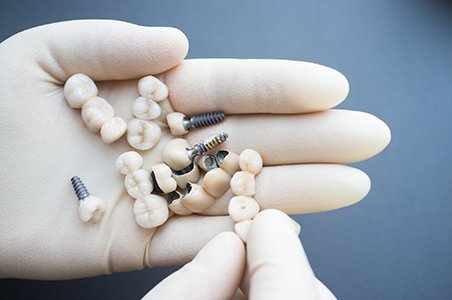
The condition of your teeth will determine what restorative procedures may be needed, such as fillings, porcelain veneers or full-coverage crowns, inlays or onlays, bridges or implants restored with a crown. In particular, your dentist will make note of any cavities and decay, tooth wear, cracks, unusually short or long teeth, root canal issues and any tooth movement.
02Periodontal (gum) tissues
If your gums are not healthy, you will most likely need scaling and root planing to treat periodontal disease. You may require more intensive treatments from a periodontist to ensure that your newly reconstructed teeth will have a solid foundation. Such treatments could involve soft tissue or bone grafts to build up your gums and underlying jawbone. Your dentist will look for deep pockets, excessive or insufficient gum tissue, periodontal disease and bone density irregularities.
03Temporomandibular joints, jaw muscles and occlusion:
A stable bite – one in which you are not in pain when you close your mouth or chew and one that does not cause wear or destruction of your teeth – is important to your overall oral health. Occlusal changes need to be taken into consideration when your dentist plans your restorations. In fact, you may require orthodontics (dental braces) or some other type of treatment (night guard or bite reprogramming orthotic) to correct occlusion before additional restorative procedures can be performed.
04Esthetics
The color, shape, size, and proportion of your teeth, and how they appear in relation to your gums, lips, mouth, side profile, and face, are also important factors in full mouth reconstruction treatment. The examination process requires records of your mouth, such as X-rays and photographs, impressions of your upper and lower teeth, models of your teeth that are made from the impressions and a model of your bite. KDC’s specialists—including a periodontist, orthodontist, and oral surgeon—will evaluate your needs and develop a treatment plan suited to your case.
Once we have obtained all information relevant to your case, we will develop a comprehensive, step-by-step treatment plan to correct all of the problems in your mouth and complete your full mouth reconstruction.
05What Procedures Are Needed for Full Mouth Restoration?
Most full mouth reconstructions involve multiple phases and office visits. It is not unreasonable to expect treatment to take 12 months or more, depending on your situation. The following procedures may be involved, depending on your needs:
Preventive teeth cleaning and periodontal care.
Crown lengthening to expose healthy, sound tooth structure for possible crowns or bridges.
Orthognathic surgery to reposition the jaw.
Contouring of the gum tissue to create balance and harmony in your smile.
Preparation (reduction) of your natural tooth structure so crowns, bridges or veneers can be placed.
Placement of temporary restorations so you can become accustomed to your new teeth and the feel of your new mouth or bite alignment.
Placement of permanent restorations, such as fillings, crowns, veneers, inlays/onlays or bridges, made from ceramic, ceramic supported by metal or a combination of both.
Orthodontics (braces) in order to move your teeth into the optimal position for reconstruction.
Implant placement and restoration to replace missing teeth and/or anchor bridge restorations.
Bone or soft tissue grafting to enhance the stability of your teeth, proposed implants and/or other restorations.